MCQ Section
1 questions(a) The first step in the Finite Element Method (FEM) is:
- Applying boundary conditions
- Discretization of the domain
- Assembling global stiffness matrix
- Numerical integration
(b) Which method is based on the principle of minimum potential energy?
- Collocation method
- Galerkin method
- Variational method
- Least squares method
(c) A linear 1D bar element has how many nodes?
- 1
- 2
- 3
- 4
(d) For axisymmetric elements, the geometry and loading are assumed to be symmetric about the:
- X-axis
- Z-axis
- Y-axis
- Axis of rotation
(e) Which type of mass matrix distributes mass equally at the nodes?
- Consistent mass matrix
- Symmetric mass matrix
- Lumped mass matrix
- Diagonal stiffness matrix
(f) The governing equation for steady-state 1D heat conduction is:
(g) Which interpolation is used in isoparametric elements?
- Lagrange interpolation
- Newton interpolation
- Fourier interpolation
- Polynomial least squares
(h) Which equation governs fluid mass conservation?
- Navier-Stokes equation
- Energy equation
- Momentum equation
- Continuity equation
(i) In FEA software, the process of breaking geometry into small elements is called:
- Loading
- Post-processing
- Meshing
- Solving
(j) Hermite shape functions are primarily used in:
- Bar elements
- Truss elements
- Beam elements
- Tetrahedral elements
Long Answer Questions
8 questions(a) Explain the steps involved in FEM with their advantages.
(b) Derive the strain displacement equation for a 2D elastic body.
(a) Derive the consistent mass matrix of a one-dimensional bar element and compare it with the lumped mass matrix. Explain how eigenvalues and eigenvectors are evaluated for dynamic analysis of bars or beams.
(b) Describe the concept of shape functions and their properties for 1D and 2D elements.
(a) Explain the Principle of minimum potential method.
(b) Discuss the convergence criteria, error analysis, and the role of boundary conditions (homogeneous and non-homogeneous) in structural or thermal problems.
(a) Explain Simplex, Complex and Multiplex elements with examples.
(b) Describe the finite element formulation for a beam element based on Euler-Bernoulli beam theory, including the role of Hermite shape functions.
(a) A Stepped composite bar is loaded as shown in the figure. Determine the nodal displacements in the bar. , , , , , lengths are and .
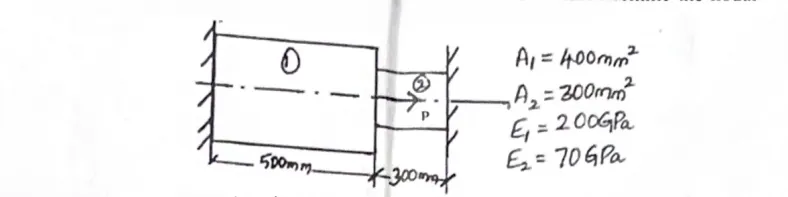
(b) Using finite element analysis, describe the procedure for analysing laminar flow in a pipe with stepped cross-sections, considering the effect of friction and heat transfer.
(a) For the beam shown in the figure, calculate the deflection under the load for the beam. , , Load .

(b) Derive the finite element formulation for steady-state 1D heat conduction using the variational method.
(a) Explain the formulation of an axisymmetric triangular finite element, and derive the stiffness matrix for an axisymmetric body.
(b) Write and explain the governing equations of 1D fluid flow (Continuity and Momentum).
(a) Describe the procedure for performing a 1D steady-state heat transfer analysis (conduction) using any standard FEA software. In your answer, include the steps of discretization, applying thermal loads and constraints, solution interpretation.
(b) Describe the steps involved from geometry creation/import, meshing, assigning material properties, applying boundary conditions, up to solving and interpreting the results.