MCQ Section
1 questions(a) Which of the following is NOT a type of elasticity of demand?
- Price elasticity
- Cross elasticity
- Income elasticity
- Capital elasticity
(b) GDP at market price includes:
- Net factor income from abroad
- Direct taxes only
- Indirect taxes minus subsidies
- Depreciation only
(c) Break-even point is achieved when:
- Total cost = Total revenue
- Profit = Fixed cost
- Fixed cost = Variable cost
- Variable cost = Total cost
(d) The unorganized sector in India is characterized by:
- Job security and benefits
- Lack of job security and irregular income
- Regular wages
- Large scale industries
(e) The estimated quantity of cement in of concrete having nominal mix 1:2:4 by thumb rule is:
- 2 bags
- 6 bags
- 4 bags
- 8 bags
(f) Detailed specification includes:
- General guidelines only
- Only quantity details
- Material, workmanship, and method of execution
- None of the above
(g) The purpose of rate analysis is:
- To fix the selling price of a product
- To measure productivity only
- To calculate total project cost per unit of work
- To prepare bar chart
(h) A tender is:
- A payment certificate
- A project report
- An offer to execute work at specified rates
- A technical drawing
(i) The primary purpose of inviting tenders is to ensure:
- Profit to contractor
- Transparency and competition
- Minimum time for project execution
- Reduction of material cost
(j) The most used method for dispute settlement in construction projects is:
- Mediation
- Arbitration
- Court litigation
- Public voting
Long Answer Questions
8 questions(a) What is Contract? Explain different types of Contracts.
(b) Explain the concept of Aggregate Demand (AD) and Aggregate Supply (AS) in the context of an open economy.
(a) Explain how break-even point helps managers in taking production decisions.
(b) Explain how managerial economics helps in managerial decision-making in an organization.
(a) Explain moving average forecasting with a simple illustration.
(b) Explain why balance sheet is called a "snapshot" of the financial position of a business.
(a) Discuss the changing contribution of the primary, secondary, and tertiary sectors to India's GDP after reforms.
(b) Describe the role of direct benefit transfer (DBT) in improving social outcomes.
(a) Estimate the quantities using Centre line method for the given plan:
- Earthwork in excavation in foundation
- P.C.C in foundation
- 1st class Brickwork in cement mortar 1:6 in superstructure.
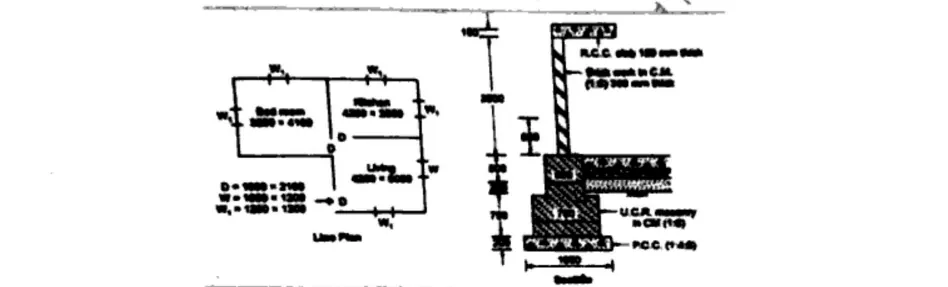
(b) A RCC lintel size with clear span of is reinforced with 4 bars of dia. at bottom and 3 bars of at top. The stirrups of dia. are provided c/c. Bearing of lintel is . Calculate the total quantity of steel reinforcement.
(a) Estimate the quantities of materials required for a RCC roof slab thick with 1% reinforcement for a room having internal dimension . Estimate the cost of construction of the roof slab with suitable rates of materials and taking labour rate of laying including centering and shuttering etc. as ₹80.00 per cum of RCC work.
(b) Prepare rate analysis for plastering thick in cement mortar 1:3. Assume suitable data if needed.
(a) Calculate the quantity of earthwork for length for a portion of a road in a uniform ground height of bank at the two ends being and . The formation width is and side slope 2:1 (Horizontal : Vertical). Assume that there is no transverse slope.
(b) Write the rules for deduction in painting work for doors and windows as per IS 1200. Also discuss the important points which should be considered while taking measurements.
Write short notes on any four of the following:
(a) Termination of Contracts
(b) Direct & Indirect Overheads
(c) Importance of inviting tenders
(d) Detailed specification for industrial structures
(e) Factors affecting task work
(f) Penalty and Liquidated charges in contracts