MCQ Section
1 questions(a) Stress concentration in a machine component of ductile material is not so harmful as it is in brittle material because:
- In ductile material local yielding may distribute stress concentration
- Ductile material has larger Young's modulus
- Poisson's ratio is larger in ductile material
- Modulus of rigidity is larger in ductile material
(b) If the size of a standard specimen for a fatigue testing machine is increased, the endurance limit for the material will:
- Have same value as that of standard specimen
- Decrease
- Increase
- None of the above
(c) Two solid shafts A and B are made of the same material, and A is twice the diameter of B. The torque that can be transmitted by A is:
- 2 times that of B
- 4 times that of B
- 6 times that of B
- 8 times that of B
(d) If the load on a ball bearing is halved, its life:
- Remains unchanged
- Increases two times
- Increases four times
- Increases eight times
(e) Which of the following is not a type of welding joint?
- Lap joint
- Butt joint
- Tee joint
- Single strap joint
(f) A brake commonly used in motor cars is:
- shoe brake
- band brake
- band and block brake
- internal expanding brake
(g) Absolute viscosity of the lubricant in , Speed of the journal in r.p.m., and Bearing pressure in , then the bearing characteristic number is:
(h) In leaf springs, the longest leaf is known as:
- lower leaf
- master leaf
- upper leaf
- none of these
(i) Lewis equation in spur gears is used to find the:
- tensile stress in bending
- shear stress
- compressive stress in bending
- fatigue stress
(j) Which of the following is antifriction bearing?
- journal bearing
- pedestal bearing
- collar bearing
- needle bearing
Long Answer Questions
8 questions(a) Explain the general considerations in machine design.
(b) A rotating steel shaft is supported at the ends. It is subjected to a point load at the center. The maximum bending stress developed is . If the yield, ultimate & corrected endurance strength of the shaft material is , & respectively, find the factor of safety for the shaft.
(a) Explain wedge film and squeeze film journal bearings.
(b) A lightly loaded full journal bearing has journal diameter of , bush bore of and bush length of . If rotational speed of journal is and average viscosity of liquid lubricant is , calculate the power loss.
(a) Discuss the failure of a riveted joint under different stresses.
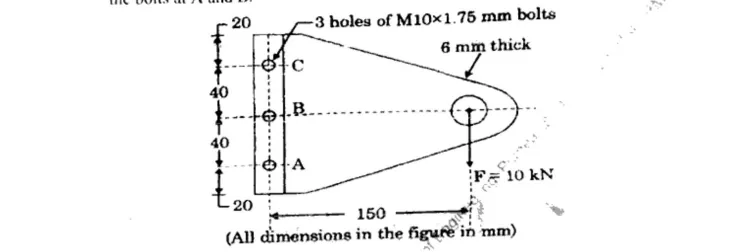
(b) A bolted joint is shown in the figure below. Calculate the maximum shear stress in the bolts at A and B.
(a) With the help of neat sketches, differentiate between single and multi plate clutches.
(b) A single plate clutch, effective on both sides, is required to transmit at Determine the outer and inner diameters of frictional surface if the coefficient of friction is , ratio of diameters is and the maximum pressure is not to exceed . Also determine the axial thrust to be provided by springs. Assume the theory of uniform wear.
(a) A bearing supports a radial load of and a thrust load of . The desired life of the ball bearing is revolutions at . If the load is uniform and steady, service factor is , radial factor is , thrust factor is , and rotational factor is . Calculate the basic dynamic load rating of a bearing.
(b) A long and thick fillet weld carries a steady load of along the weld. The shear strength of the weld material is equal to . Calculate the factor of safety.
(a) Derive the Lewis Equation for the beam strength of a gear tooth.
(b) A bronze spur pinion rotating at drives a cast iron spur gear at a transmission ratio of . The allowable static stresses for the bronze pinion and cast iron gear are and respectively. The pinion has standard full depth involute teeth of module . The face width of both the gears is . Find the power that can be transmitted from the standpoint of strength. Tooth form factor is given for full depth involute .
(a) What is nipping in a leaf spring? Discuss its role. List the materials commonly used for the manufacture of the leaf springs.
(b) A helical spring is made from a wire of diameter and has outside diameter of . If the permissible shear stress is and modulus of rigidity , find the axial load which the spring can carry and the deflection per active turn.
(a) A spur gear has a module of , number of teeth , a face width of and a pressure angle of . It is transmitting a power of at . Taking a velocity factor of , and Modified Lewis form factor of , find the stress in the gear tooth.
(b) Write short notes on any two of the following:
- Stress concentration
- Fatigue loading
- Welded joints
- Sliding contact bearing